· 11 min read · AI, Process, Industry
AI workflows in a software company, part 2: faster is not better
AI can now write code faster than a team can read it. We know it can code. What I want to figure out is what a sane workflow around it looks like, over the whole cycle and not just design. The design side is in part 1.
I'm not against AI-centered workflows. They work, and most teams will end up using them anyway. But they have side effects, and it's a lot easier to plan for those from day one than to clean up later. That's really what this post is about.
What the numbers say
At Google and Anthropic most new code is now written by AI, if you take their word for it (about 75% at Google, Semafor, Apr 2026, and over 80% at Anthropic, May 2026). Nine out of ten developers use coding agents every week (JetBrains, Aug 2026). Whether any of this makes people faster is much less clear, and the quality numbers aren't great. Duplicated code is up 81% since 2023 (GitClear 2026, vendor data), 38% of AI code still fails security checks (Veracode, Oct 2026), and developers mostly trust AI output only when they can easily check it (Stack Overflow survey 2026).
My reading is that AI makes writing cheap and leaves everything after writing as expensive as it was. Good teams get faster, weak processes get weaker. DORA calls AI an amplifier (2025, so dated, but the idea holds). These numbers will age fast anyway, Claude 5 was a big step.
Stage by stage
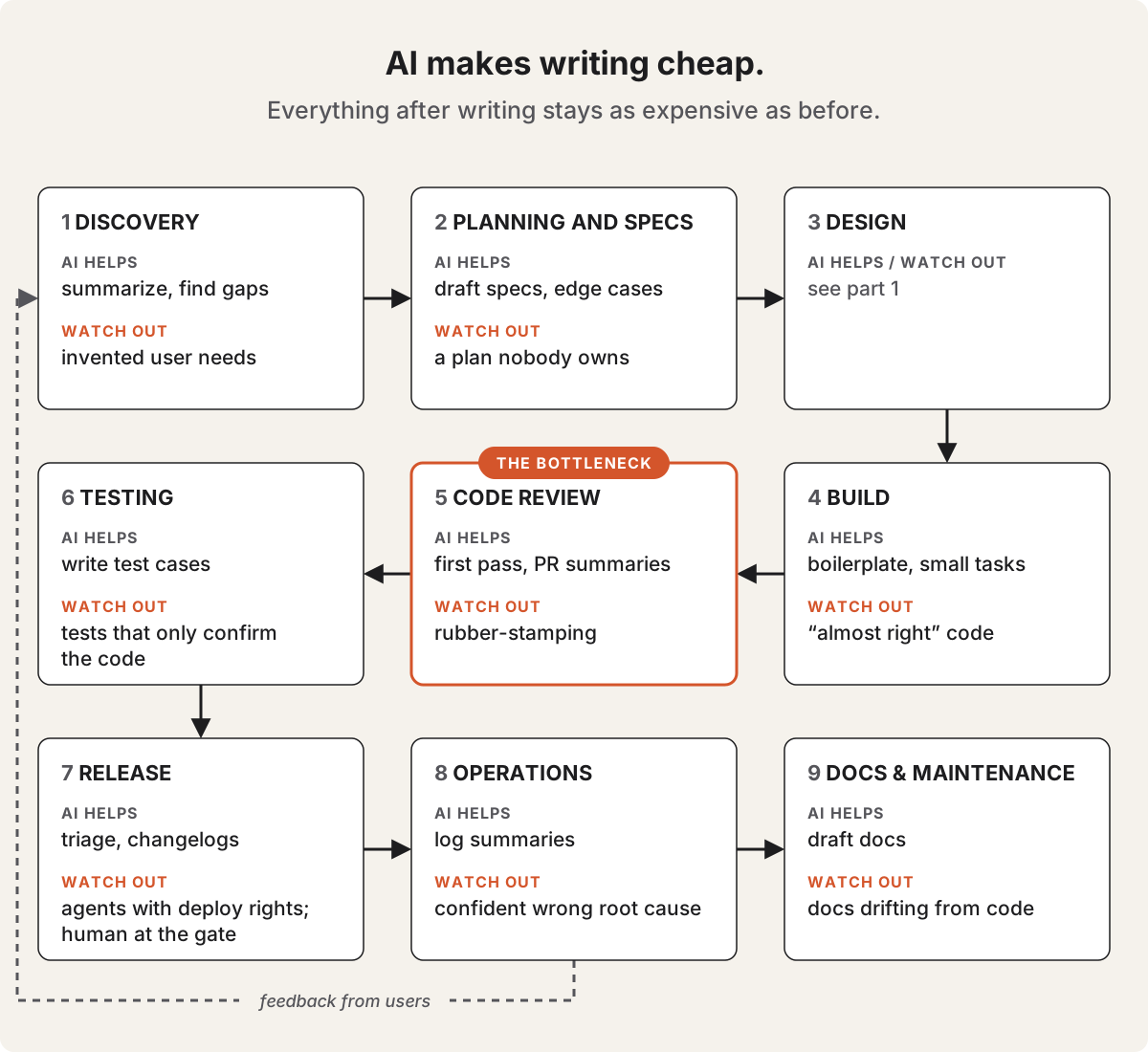
AI helps at every stage, from summarizing a messy brief to drafting a postmortem. Every stage also has its own way of going wrong. In discovery it invents user needs, because it averages opinions and never meets a user. In planning you get a confident plan nobody owns. Then there's "almost right" code, tests that only confirm what the code already does, a wrong root cause stated with full confidence, and docs that drift away from the code until nobody knows why something exists. I'd also keep a human at the release gate and not hand deploy rights to an agent.
And code review is where it all piles up. More code arrives than people can read.
The technical problems that repeat
Review is the big one. Someone has to check all that code, and a named human has to own every change, because "the AI wrote it" is not an owner. Tokens also cost money, which people tend to forget until the bill shows up.
AI still makes up packages that don't exist. Current models do it less often, but not never (arXiv preprint, 2026). Attackers can register those made-up names, so check that every dependency exists and is the one you meant.
Then security in general. Prompt injection is still number one on OWASP's 2026 list for LLM applications, and "excessive agency" moved up to third. For agents I like Simon Willison's lethal trifecta (2025, dated, but a good rule of thumb). Private data, untrusted content and a way to send data out. Never give one agent all three.
Faster building is not a better company

Photo: Igor Ovsyannykov, CC0
A prototype in minutes instead of days doesn't make the whole company faster. Building was never the only slow part. Fred Brooks wrote in 1987 that the hardest part of software is deciding what to build. By my own rule that's hopelessly out of date, and it still holds. Marty Cagan says much the same now that building is cheap, "the real bottleneck is in discovering a solution that's worth building" (Apr 2026).
So even a very AI-centered company needs people who understand the customer, what they want and what they'd actually pay for. It needs people who sell the product, because the goal is selling and keeping customers, and a product nobody buys is just a very fast mistake. It needs someone who knows which upgrades are needed, out of the hundred that are now possible. And someone who cares whether an upgrade makes users happy, which is UX. A feature that works but is annoying doesn't win anyone over.
Somebody also has to follow the product after launch, with support, feedback and fixes. A support conversation is the cheapest user research there is, and it tells you what to build next. That's my view, I found no solid study on it.
The people problems
These are easy to miss, because the dashboards look great while they happen.
Skills fade, in every role
It's not only developers either. There are older signs from medicine, where doctors who got used to AI help got worse at spotting things on their own (colonoscopy study, 2025, dated). I found nothing that measures it for business analysts or project managers, but I'd expect the same. If the AI writes your requirements, your roadmap and your meeting summaries, you stop practicing the thinking you need to judge them.
This trap is old. Bainbridge called it the "ironies of automation" back in 1983. The more you automate, the more you depend on the skills of the human who steps in when it fails, and that human gets less and less practice.
Teams dissolve into individuals
Photo: Jadon Barnes, CC0
One person with AI has so much power that they don't need to ask anyone anymore. They just talk to the AI.
There's some older data on this. After Copilot came in, developers moved toward more solo, less collaborative work (2024, dated). In a P&G experiment, individuals with AI did as well as teams without it (2025, dated). That's good news in a way, and it's also exactly how it happens. If AI can replace some of the collaboration, people will skip it.
What worries me is a company where everyone works fast on their own and nobody else understands the result. Shared understanding gets thin, the "what if she leaves?" problem gets worse, and colleagues stop learning from each other. I haven't seen a study of that under AI, it's my own reasoning.
Workslop

Photo: NARA, public domain
Piles of AI-made documents that nobody reads. Researchers at Stanford and BetterUp gave it a name and a definition, "AI-generated content that looks good, but lacks substance."
The sender saves time and the receiver pays for it. When making a document costs nothing, people's attention is what gets expensive.
Work gets more intense
Everything starts to look the same
In one experiment, stories written with AI help were rated more creative, but they were also more alike (2024, dated). For designers that's a warning. Without strong direction, AI pulls everything toward the average.
The junior pipeline

Photo: Jared Sluyter, CC0
Juniors used to learn on the grunt work, and now the machine does the grunt work.
The rest of the data is mixed. Junior software vacancies fell 14 to 15% relative to senior ones (IZA, Jun 2026), while a Danish study found no significant effect on earnings or hours overall (NBER, revised Mar 2026). But if the machine does the junior work, who becomes the senior?
What it should look like
None of this is a reason to avoid AI-centered workflows. It's a reason to build the countermeasures in from the start. A few have research behind them, most are just sensible practice.
- People decide what to build and when it's done. That stays human.
- Give the AI small jobs with clear edges, one task and one small PR at a time. DORA found small batches work especially well with AI (2025, dated).
- Tests and specs are your guardrails. Whatever a machine doesn't check, a person has to.
- Run agents in a sandbox, with as few rights as possible, no production secrets and a log of what they did.
- Measure what the business actually cares about, like customers, revenue, retention, support load and happy users. Lines of code and the number of features shipped tell you very little.
- Do some work without AI on purpose, so you don't forget how. Some engineers at Anthropic practice without it deliberately. And use it to explain things to you, not only to produce things for you.
- Keep people talking. Shared reviews, pairing, short design and spec reviews with at least two people. Write decisions down somewhere that outlives the AI chat. I found no research that proves this one works, it's just common sense to me.
- If you send a document, you've read it and you stand behind it. If you haven't read it, it doesn't go out. That alone kills most workslop.
- Protect the pauses. The Berkeley researchers suggest what they call an "AI practice", with structured pauses before big decisions, batching of work and protected time for check-ins with actual humans.
- Juniors need real tasks, real review time and a mentor, and not only whatever the machine left over.
- Stay with the product after launch. Support, feedback and fixes show you which upgrades matter.
And don't trust any of these numbers for your own team. Good numbers are notoriously hard to get, self-reported ones especially. In METR's 2025 study (dated), developers believed they were faster with AI when they were actually 19% slower.
Photo: Kai Oberhäuser, CC0
AI is an amplifier. A company with clear goals, good communication and care for its users will get a lot faster with it. A company without those will mostly get faster at going nowhere.
Sources
2026 (current)
- Semafor: Google CEO on AI-generated code (Apr 2026) - the 75% claim, press report with no method
- Anthropic Institute: When AI builds itself (2026) - more than 80% of merged code, vendor self-report
- METR: changing our developer productivity experiment (24 Feb 2026) - new estimates and why they are weak
- GitClear: the maintainability gap (2026) - 623M changed lines, vendor research
- Stack Overflow 2026 survey (6 Oct 2026) - results and method
- Stack Overflow 2026: AI trust data - the trust question and answers
- Veracode: AI code security pass rate (29 Oct 2026) - 62% pass rate, vendor data on raw models
- JetBrains: AI coding agent adoption (Aug 2026) - 15,000+ developers, self-reported
- Package hallucinations on the 2026 frontier models (arXiv preprint) - lower than in 2024, not zero
- OWASP GenAI: LLM Top 10 2026 - the 2026 edition
- Help Net Security: OWASP 2026 LLM Top 10 (Aug 2026) - prompt injection first, excessive agency third
- Anthropic: AI assistance and coding skills (29 Jan 2026) - randomized trial, 52 engineers, vendor-run
- Ranganathan and Ye: AI doesn't reduce work, it intensifies it (HBR, Feb 2026) - Berkeley Haas field study
- Berkeley Haas newsroom on the study (Feb 2026) - details and recommended "AI practice"
- Stanford: Canaries in the Coal Mine (revised Aug 2026) - early-career employment, descriptive
- IZA: AI and entry-level software work (Jun 2026) - junior vacancies fell relative to senior
- NBER: Still waters, rapid currents (revised Mar 2026) - Danish data, no significant earnings or hours effect
- Marty Cagan: Build to learn vs build to earn (16 Apr 2026) - the bottleneck is discovery, an opinion piece
Before 2026 (out of date, used for direction only)
- METR: early-2025 AI and experienced open-source developers (Jul 2025) - the 19% slowdown, with the authors' caveats
- DORA 2025: State of AI-assisted software development (Sep 2025) - the "amplifier" quote
- Google Cloud: DORA AI Capabilities Model (Sep 2025) - user-centric focus, small batches
- Simon Willison: the lethal trifecta (Jun 2025) - agent security rule of thumb
- Fred Brooks: No Silver Bullet (1987) - essential versus accidental difficulty
- Bainbridge: Ironies of automation (1983) - the automation trap (record and abstract only)
- Anthropic: How AI is transforming work at Anthropic (Dec 2025) - survey of 132 engineers, the "paradox of supervision"
- Budzyn et al.: colonoscopy deskilling (Lancet Gastro and Hepatology, Aug 2025) - detection fell from 28.4% to 22.4%
- Hoffmann et al.: Generative AI and the nature of work (2024) - Copilot rollout and collaboration
- Dell'Acqua et al.: The Cybernetic Teammate (NBER, Apr 2025) - P&G field experiment, counter-evidence
- Niederhoffer et al.: workslop (HBR, Sep 2025) - Stanford and BetterUp
- BetterUp: workslop research - definition, survey figures, modelled cost
- Doshi and Hauser: AI and creativity (Science Advances, Jul 2024) - more creative, more similar
Comments